( 1 ) THE EARLY PRE-HISTORY
Recent archaeological finds in India have pushed back the origins of late Stone Age settlements in India to as early as the 8th Millennia B.C. These include the familiar late Stone Age hunter-gatherer as well as the later agriculturists’ settlements.Evidence of domestication of cattle, buffalo, sheep and goats and use of pottery and copper and iron objects has also been found in these sites.And these sites have been widespread in many parts of the subcontinent, from Baluchistan in the west, to Bengal in the east and from North-West Frontier Province in the north, to Sri Lanka in the south.
A site found at Maraiyur in the eastern foothills of Kerala and dating between the 8th and 2nd Millennia BC revealed paintings, drawings and engravings on the interior of a rock wall 39ft high and 31 ft wide.At Langhnaj in Gujarat was a sand dune that showed evidence of long human occupation dating from the 6th to the 3rd Millennia. At similar sites in Bagor near Udaipur in Rajasthan and at Langhnaj, copper objects and pottery were found.The first settlements in Baluchistan resemble the agricultural societies of Euphrates-Tigris and the Nile basin.Radiocarbon dating of these settlements put them at around 3,500 BC.
These settlements and sites such as Mundigak in Southeastern Afghanistan and others such as from the Quetta valley (Kili Ghul Mohammad) appear to be semi nomadic pastoralism with only minimal cultivation.While some degree of domestication and use of copper and clay pottery were present, permanent structures were not constructed; city dwelling would be sometime in the future.This middle period of development proceeded until around 2500 BC, after which the fully developed city-dwelling civilizations emerged. As a consequence of the appreciation of the agricultural potential of the Indus floodplains, many pre-Indus valley civilizations developed. Examples of these are found at Amri, at Kot Diji just north of Amri and Kali Banga, the latter on the banks of Saraswati River (present day Ghaggar).
Evidence of similar settlements is to be found in many other parts of India.In the Vale of Kashmir, at Burzahoun near Srinagar, a settlement was dated with radiocarbon to around 2375 BC; bone and antler harpoons and needles and ground-stone axes were used by the settlers.Other sites were found in widely separated locations such as in Karnataka, Andhra Pradesh as well as in Assam and central India.All these populations used stone axes and pottery of different grades. For example, in Assam cord-impressed pottery was found, whereas burnished gray pottery was the style in Kashmir and Karnataka.
B): THE INDUS VALLEY CIVILIZATION AND ITS CONTEMPORARIES:
“ India confronts Egypt and Babylonia by the 3rd Millennia with a thoroughly individual and independent civilization of her own, technically the peer of the rest.And plainly it is deeply rooted in Indian soil.The Indus civilization represents a very perfect adjustment of human life to a specific environment.And it has endured; it is already specifically Indian and forms the basis of modern Indian culture”.V. Gordon Childes’ words were in tribute to the city dwellers of Mohenjo-Daro and Harappa. Recent archaeological discoveries put Indian history into much further back in time, although the formal urban civilizations flourished between 3000 and 2300 BC.
The development of the Indus Valley civilization as exemplified by Mohenjo-Daro and Harappa is a natural sequence of events considering the fertility of the alluvial soil the river basin offered.It is also considered to be a natural extension of the earlier, semi-nomadic civilizations of Baluchistan and elsewhere in India.Much of the evidence excavated at these sites points to an indigenous Indian civilization rather than an imported one, for example, from Mesopotamia.However, ample evidence exists for contacts between these and other cultures including the Persian, Mesopotamian as well as the far east, the latter represented by the Chinese.
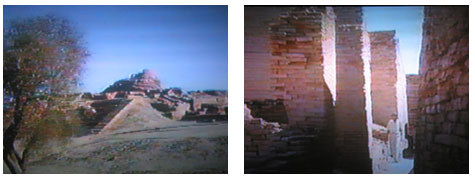
IMAGES FROM ARCHAEOLOGICAL SITES IN MOHENJO-DARO
Evidence for settlement in the floodplains of the Indus has been dated back to the beginning of the 3rd Millennium.The site evidently offered an excellent opportunity for agriculture.Rapidly, these settlements expanded and developed into discreet societies, spreading north and east and by the middle of the millennium, reached as far as Kali Banga. Other sites included Chanhu-daro, Kot Diji and Amri. In most instances the transformation seems to have been peaceful but at least in the latter two sites there is suggestion of violent upheaval, as evidenced by thick layers of ash.

Even this early, certain practices that can be considered distinctly Indian appeared, some of which already point to roots of Hinduism.An example of the latter is found in the form a seated yogi and objects reminiscent of Shiva lingam (a phallic representation of the Lord Shiva).Bullock carts with framed canopy and the shape of boats are almost unchanged to this date.Women wore elaborate ornaments and bangles, another distinctive Indian trait.These people built great granaries and citadels, the latter bearing similarities with Mesopotamian structures.Their greatest achievement, however, was the exquisitely planned cities with roads and streets laid out in a grid pattern.The houses were made of burnt brick; they had living quarters built around a central courtyard and many also had sewage system for removal of waste into municipal sewage through drainage chutes.Communal baths were also a common feature and these predate Roman baths by at least a millennium.Most the houses had private wells and at least one bathroom.
Agriculture and domestication:
Animals have been regularly domesticated by the inhabitants of all the Indus Valley settlements. Wheat, barley and rice were among the cereals cultivated by these peoples. Other crops include dates, melon and several legumes.The cultivation of cotton was of course, of importance for textile manufacture. Buffalos, cattle, camels, pigs, cats, dogs, sheep, goats and fowl were all domesticated by these peoples.
Tools and implements:
Copper and bronze were used for making tools and implements.Knives, spears, arrows, razors and chisels were all used by all the Indus Valley civilizations. Also in evidence is use of gold, silver and lead.Another specialty of the civilization was the use of pottery. An enduring industry and one that India is famous for was already in evidence in Indus valley centers; it is the textile industry using cotton grown locally.
Trade:
Evidence for trade between Indus valley inhabitants and various other regions of India as well asthe Persian Gulf states including Mesopotamia include the Harappan seals (used to seal bundles of merchandise), as well as items unique to certain regions of both India and the other Asian countrieswith trade links with the Harappan cultures.Some examples of the latter are turquoise and alabaster (both from Iran), jade (central Asia), gold (north Karnataka), copper (from Rajasthan as well as Baluchistan and further west; amethyst (Maharashtra) and fuchsite (from Karnataka).Also, official inscriptions in Mesopotamia mention Melham (ancient Acadian name for the Indus region).
Language, Religion:
Inscriptions recovered from the Indus Valley have no resemblance to the Indo-European family (Sanskrit, Latin etc) or the middle-eastern languages.Although it seems to be written from right to left, the closest resemblance is thought to be with the Dravidian languages (Tamil, Telugu, Kannada , Malayalam and Tulu). Final word on the deciphering of the recovered inscriptions is awaited.Religious practices seem to indicate distinctly Indian attributes. A belief in a Great God (presumably Lord Shiva) and a Great Mother God (Shiva’s spouse, Parvati) and the origins of yogi in meditative posture, the swastika are clearly Indian.Some signs of influence from Mesopotamia are also evident. Cemeteries excavated at Harappan, Lothal and Kali Banga indicate a clear belief in an afterlife.
Art:
Stone sculpture, which are rare finds, vary greatly in quality.Many are of poor artistic quality but some are excellent.Cast-bronzes are generally of better quality and exemplifies technical excellence.Of most interest are probably toys; examples are monkeys pierced to climb a string and cattle that nod their heads!
The fall of the Harappan Culture is thought to have occurred after 1750 BC.The speculated causes of their decline are a catastrophic flood or a major change in the course of the Indus river that led to the dying out of the fertile area and one even more plausiblecause being the population growth outstripping the food supply and leading to deforestation.
SOURCES:
Encyclopedia Britannica
The True Path, by Roy Mathews, Perseus Publishing