THE MAURYAN EMPIRE (325 TO 185 BC):
The Mauryas occupy an important place in Indian History for three reasons. First, because it was the first true home-spun empire. Second, at its peak, its boundaries included parts of present day Afghanistan, the whole of northwestern and much of the eastern India as well as the Deccan plateau. Only the Deep South was not part of the empire and only the Mughals during their heyday and, of course, the British, controlled more land under one administration. (Please refer to the map). Third and perhaps most poignantly, this dynasty produced a ruler who was ruthless as a warrior but attained greatness once he began ruling through winning hearts rather than battles. This was the 3d Maurya ruler, the Emperor Ashoka "the Great"
The Maurya dynasty was founded by Chandragupta Maurya after he overthrew the Nanda kingdom of Magadha. His next major campaign and one that was crucial in the foundation of the empire was a war with the Greek General, Seleucus 1 Nicator in the Trans-Indus region in the year 305 BC. Seleucus was one of Alexander’s generals who founded the Seleucid dynasty in Iran. This war ended in a treaty in which Seleucus gave up the Tran-Indus provinces to Chandragupta and in return received 500 elephants. Both Chandragupta and Seleucus had a lengthy and fruitful alliance and many of the written observations of the Maurya kingdom came from some of Seleucus’ envoys. One such envoy, Megasthenes wrote a book entitled “Indica”
In addition to this work, a major contribution came from Chandragupta’s Prime Minister Chanakya (or Kautilya); this was called “Artha-Shastra”. It dealt with both political and economic matters of importance. For many centuries, additions were continually made to this influential compilation.
The second monarch of the Maurya dynasty, Bindisara ascended the throne when Chandragupta abdicated to follow the strict teachings of Mahavira and Jainism. His rule was not noted for any significant achievements but he did extend the empire southward, up to the present day Karnataka.
ASHOKA THE GREAT: (304-232 BC):
“Amidst the thousands of names of monarchs that crowd the columns of history, their Majesties and Graciousnesses and Serenities and Royal Highnesses and the like, the name of Ashoka shines, and shines alone, a Star”
H.G. Wells in his book “The Outline of History”
The above accolade and many others from historians were bestowed upon Emperor Ashoka, the third monarch of the Maurya dynasty, for many reasons. The fact that he brought much of India, Afghanistan and parts of Persia under one rule, while in itself is a feat unmatched by any other monarch in Indian history, is not why Ashoka qualifies as a luminary in the annals of world history. It has more to do with the way he governed and conducted himself as a benevolent ruler, who was not only concerned for his fellow citizens but also the animals as well as the flora under his stewardship. The principles he espoused during his tenure as the emperor of his vast kingdom, were well ahead of his time. In fact, many administrations in the ‘modern’ 21st century world nations will fail miserably in the way in which they manage the welfare of their citizens, as well as the other denizens and of the land itself. Ashoka is also credited with spreading the compassionate and enlightened religion of Buddhism, not only to all of India, but also to the rest of Asia, including some parts of “Middle Asia”. However, he was tolerant of all the other religions and treated them as equals.
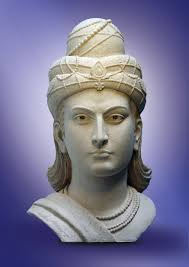
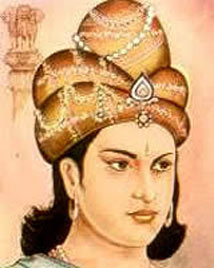
TWO IMAGES OF ASHOKA
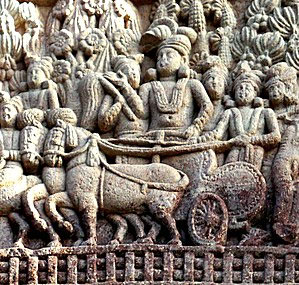
Emperor Ashoka in his chariot, from a bas relief from Sanchi
This is reproduced from Wikipedia
ASHOKA’ S REIGN (268-232 BCE):
Ashoka was born in the year 304 BCE, as the grandson of Chandragupta Maurya, who started the Maurya Dynasty. From an early age, Ashoka showed the traits of a great warrior, so much so, when rebellion broke in Ujjain, his father Bindusara dispatched him to quell it. Thus began Ashoka’s ascendancy. However, as his father Bindusara had chosen the eldest son Sushima to succeed him, there was a power struggle. Most the ministers in Bindusara’s court did not favor Sushima, however, because they considered him too arrogant. These ministers, particularly one called Radhagupta favored Ashoka and thus, a council of ministers led by him installed Ashoka as the Emperor.
During the first eight years of his reign, Ashoka embarked on a mission of conquest and managed to annex much of Northern India and even Gandhara (present day Afghanistan) and parts of Persia. However, the southern-most regions of India, which were
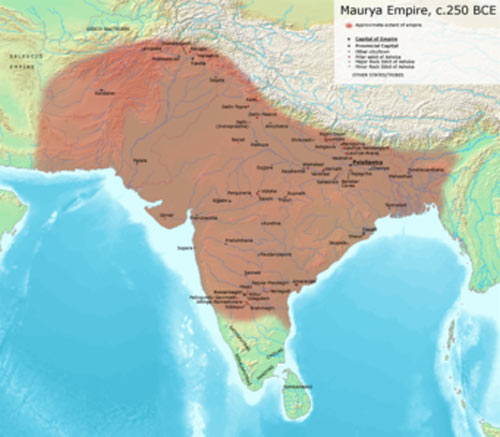
ASHOKA’S EMPIRE
The above map is reproduced from Wikipedia
under the control of Chera, Chola and Pandya kingdoms, were never conquered. The final war that Ashoka engaged in was the fateful “Kalinga war”. Kalinga (present day Odisha) was never before conquered by other kingdoms. After the particularly bloody war, Ashoka, having witnessed the death and destruction, had a change of heart. More that 100,000 soldiers were killed during this war and the site of the war was filled with their corpses. Also, a further 150,000 people were injured and the city lay in ruins. Ashoka embraced the Buddhist religion and vowed never again to engage in wars; he would win the hearts of his subjects by his good deeds, instead.
ADMINISTRATION:
In addition to being an excellent warrior, Ashoka was an able administrator. All important matters of the state were discussed with his “Advisory Council”, which comprised of the Yuvaraj (Crown Prince), Mahamantri (Prime Minister), Senapathi (General) and the Purohita (Priest). His empire was divided into Pradesha (Provinces), which in turn were divided into Vishyas (subdivisions) and these in turn into “Janapadas and villages”. The provinces were Uttarapatha (Northern Province) with Thakshasila as its capital, Avantiratha (Western Province), with Ujjain as its capital, Pracheyapatha (Eastern Province) with Toshali as its capital and the Dakshinapatha (Southern Province) with Suvarnagiri as its capital. The empire’s capital was in Pataliputra (present day Patna). Each province was administered by a Crown Prince, who was transferred at frequent intervals to prevent them from becoming too powerful. In addition, Ashoka appointed several reporters who reported to him about the affairs of the Provinces. While the provinces were given a certain degree of autonomy, the emperor retained control over financial and administrative matters.
BUDDHIST MISSION:
Ashoka adopted Buddhism as the state religion of his empire and undertook the task of spreading the Buddhist teachings in India and abroad as his life’s mission. He sent his son Mahinda (Mahendra) and his daughter Sanghamitra to Sri Lanka (Tamrapani during Ashoka’s time). Missionaries were sent to places outside of India, such as Tibet, China, Japan and other East Asian and South Eastern countries. Also emissaries were sent to the Middle Eastern countries, Greece and Egypt. The Buddhism that spread to East Asia became known as Mahayana Buddhism and the branch that spread to Sri Lanka and Thailand is known as Theravada Buddhism (Please check our section at www.indiancentury.com/hist5.htm). History would record that his efforts yielded good results as most East Asian countries officially or unofficially adopted Buddhism as their state religion as well. Similarly, the countries bordering India also became majority Buddhist countries and remain so even today. These countries are Sri Lanka, Bhutan, Myanmar (formerly Burma) and Tibet. The greatest irony in the annals of Buddhism is the fate that befell it in India. Within a few centuries after Ashoka declared Buddhism as the state religion and most of India adopted it, Hinduism had a resurgence. Ever since, Hinduism has remained dominant in India. In fact, Hinduism actually adopted the Buddha as an Avatar of Vishnu, a blatant attempt to absorb Buddhism into Hinduism.
ASHOKA PILLARS AND EDICTS:
During the rest of his reign, Ashoka spent a great deal of time and resources in spreading the compassion and universal love preached by the Buddha. In this process, the erection and the inscriptions known as ‘Edicts’ would play a major role. These Ashoka pillars were erected all across his empire. The pillars were constructed with stone and finely polished, each pillar weighing 50-100 tons. The inscriptions were in the Brahmi script. On the top of each pillar was a ‘capital’, of which, the four lion capital (four lions with their backs to one another) in Sarnath is the most spectacular. This has been adopted as the State Emblem of India.
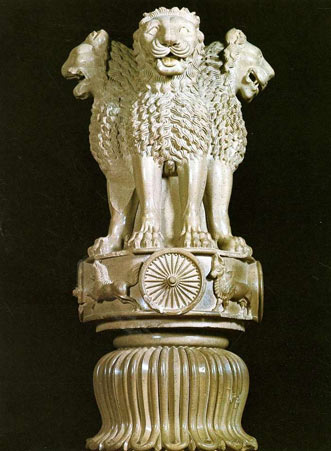
This is the four lion capital at the top of the Ashoka Pillar
At Sarnath, which has been adopted as the Emblem of modern India
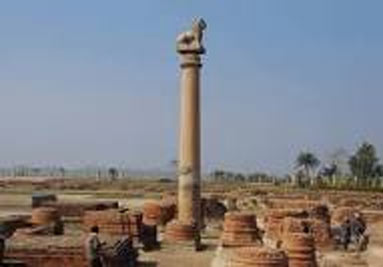
Ashoka pillar at Vaishali
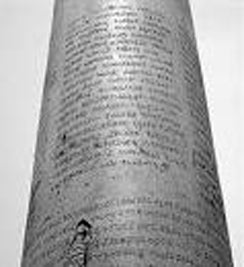
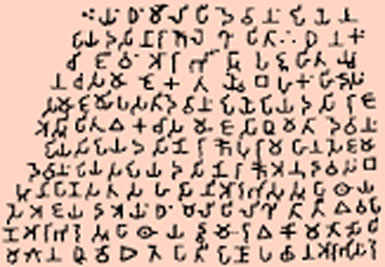
The above images show examples of Edicts on Ashoka Pillars
These inscriptions were personal messages from the Emperor to his subjects and they were meant to give guidance in leading a more just, more spiritually based society, encompassing a moral society as well as instructions on individual morality. His tone in these Edicts was not bombastic and dry, like the usual royal proclamations. Instead, Ashoka used a personal note, addressing his subjects as his children and himself as “Beloved-of –the –Gods”. In some of the Edicts he apologized to his people for the Kalinga war and asserted his desire not to have conflicts with his neighbors. In other words, mutual respect and peaceful coexistence between the kingdoms outside of his domain were stressed.
Here is how the Indian historian Romila Thappar characterized Ashoka’s principles: “His Dhamma did not derive from divine inspiration, even if its observance promised heaven. It was more in keeping with the ethics conditioned by the logic of given situations. His logic of Dhamma was intended to influence the conduct of categories of people, in relation to each other. Especially where they involved unequal relationships.”
Below, we will present the first four inscriptions. The reader is directed to a website that deals with all the known Edicts in detail: Please visit: www.Cs.colostate.edu/~malaiya/ashoka.html
Edict#1: “Beloved-of-the-Gods, King Piyadasi, has caused this Dhamma edict to be written. Here, (in my domain) no living beings are to be slaughtered or offered in sacrifice. Nor should festivals be held, for Beloved-of-the-Gods, King Piyadasi, sees much to object to in such festivals, although there are some festivals that Beloved-of-the-Gods, King Piyadasi, does approve of”.
Edict #2: “Everywhere within Beloved-of-the-Gods, King Piyadasi’s domain, and among the people beyond the borders, the Cholas, the Pandyas, the Satiaputras, the Keralaputras, as far as Tamraparni and where the Greek King Antiochos rules, and among the kings who are neighbhors of Antiochos, everywhere has Beloved-of-the-Gods, King Piyadasi, made provision for two types of medical treatment: medical treatment for humans and medical treatment for animals. Wherever medical herbs suitable for humans or animals are available, I have had them imported and grown. Wherever medical roots or fruits are not available, I have had them imported and grown. Along roads I have had wells dug and trees planted for the benefit of humans and animals.
Edict #3: “Beloved-of-the-Gods, King Piyadasi, speaks thus: “Twelve years after my coronation this has been ordered—everywhere in my domain the Yuktas, the Rajjukas and the Pradesikas shall go on inspection tours every five years for the purpose of Dhamma instruction and also to conduct other business. Respect for mother and father is good, generosity to friends, acquaintances, relatives, Brahmans and ascetics is good, not killing living beings is good, moderation in spending and moderation in saving is good. The Council shall notify the Yuktas about the observance of these instructions in these very words.”
Edict #4: “In the past, for many hundreds of years, killing or harming living beings and improper behavior towards relatives, and improper behavior towards Brahmans and ascetics has increased. But now due to Beloved-of-the-Gods, King Piyadasi’s Dhamma practice, the sound of the drum has been replaced by the sound of the Dhamma. The sighting of heavenly cars, auspicious elephants, bodies of fire and other divine sightings have not happened for many hundreds of years. But now because of Beloved-of-the Gods, King Piyadasi promotes restraint in the killing and harming of living beings, proper behavior towards relatives, Brahmans and ascetics, and respect for mother, father and elders, such sightings have decreased.”
FINAL ANALYSIS, AND THE SIGNIFICANCE OF ASHOKA
It is not difficult to understand why this complex and extraordinary person managed to conquer much of India and the rest of South Asia and then walked away from conquest entirely. His ability of conquering lands was matched by the kindness he showed towards his subjects. Even more extraordinary is the fact that he included all animals and plants among his subjects and thus equally deserving of his care. Thus, when he constructed hospitals, wells and way stations all across his empire, he included such facilities for animals as well. He advised his subjects not to cut down forests wantonly, as the ecosystem would be disturbed by such actions. Remember, these recommendations were made two Millennia ago; there are rulers in the present day world, who do not understand the value of such actions. When he accepted Buddhism for its teachings of compassion, truthfulness, ahimsa (nonviolence) and respect for all living beings and universal love, he incorporated such teachings in his edicts, for the subjects to follow as well. The very fact that he considered his subjects as his children, at once attests to his compassionate and caring nature. His eagerness to be a just ruler was always on display. The innovation of inscribing edicts on the pillars that he erected all across the empire as the way to connect to his subjects and those edicts themselves attest to the emperor’s thinking and his ideals. True to the teachings of the Buddha, towards the end of his life, Ashoka gave away much of his personal wealth; he died peacefully thereafter.
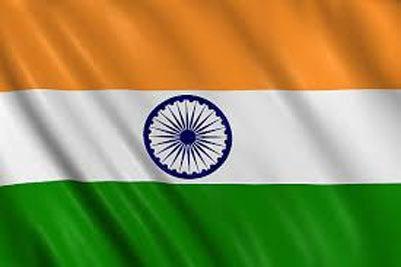
Finally, the very fact that modern India has borrowed from Ashoka two symbols (the Ashoka capital of four lions seated back to back and the “Wheel of Dharma”) underlines the profound influence he has had on India and Indians, through the Millennia. This will, endure forever, through these two symbols. The place occupied by the Wheel of Dharma in the Indian national flag is shown below:
The Mauryan Government, Economy and Society:
This empire was a centralized bureaucracy with the Emperor at the helm. Through his ministers, his extensive travels throughout his empire and through the edicts, Ashoka kept in touch with his subjects. The main source of income was the land revenues and to a lesser extent, from trade. Both the land and the produce of the land were taxed. The society was structured around endogamous castes - philosophers( which included the priests and monks and religious teachers), soldiers, herdsmen, artisans, magistrates and councilors) and the professions were considered hereditary.
The empire was divided into four provinces, each ruled by a prince. These provinces were then divided into smaller denominations, which were headed by local officers. The most powerful local officer in a city was the City Superintendent (“nagaraka”).
The Ashoka Pillars:
During this golden age of Indian civilization, Ashoka is remembered for many an innovation, which would make any contemporary Indian ruler proud. Across his empire Ashoka had constructed wide roads lined on either side by shade trees (avenues) and for the tired and thirsty traveler wells and stored water were provided at stations. He constructed hospitals for caring for the sick (by any standard, a very enlightened measure that few other ancient monarchs in world history can boast) and warned against wanton destruction of forests as that would spell ecological disaster.
All the above accomplishments pale in significance to the role he played in spreading Buddhism throughout India and the rest of Asia. And in this process, a prominent role was played by his famous edicts inscribed on the pillars that he erected all across India. These pillars are now known as Ashoka Pillars, they were made of polished sandstones and were erected on bases which are called Stupas. The most famous of these is the one at Sarnath, sporting the heads of four lions on top. These images have been immortalized by modern India as the National Emblem (see our link at the beginning of “Historical India”). Also, immortalized was the “Wheel of Dharma” found on the base holding the animals as it is now in the middle of the Indian flag. The pillars were virtual emissaries from Ashoka as they carried inscriptions in “Prakrit” form of Sanskrit on the practice of Dharma (variously interpreted as one’s duty, universal law, the social order or righteousness). Very few of these pillars still survive but each sported the image of at least one animal’s head on top; besides lions, elephants and bulls were other examples.