The Decline and Fall of the Mughal Empire
THE MUGHALS
History accords the Mughals a special place, both as a memorable dynasty that left remarkable edifices but also as one that ruled over much of India. Only the British managed to control more land and even Ashoka the Great did not extend his empire into south India. A notable contrast with the British (and the other European colonial powers) however, is the fact that the Mughals also absorbed Indian traditions and especially Akbar also tried to synthesize an amalgam of Indian and Mughal life styles.
FOUNDING OF THE EMPIRE:
BABUR: (AD 1526-30)
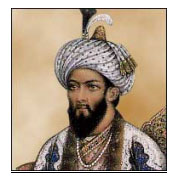
The founder of the Mughal Empire, Babur (Zahir-ud-din Muhammad) was a descendent of both Timur on the paternal side and Genghis Khan on the maternal side. He was the ruler of Kabul while Sikandar Lodi built the new city of Agra. Babur had attempted to invade India five times but only succeeded in 1526, at the Battle of Paniput. There he defeated the Sultan Ibrahim Lodi and set up the new empire. He sent his son Humayun to Agra, the capital of Sultan Lodi to capture the palaces and treasures of the Sultan. Within two years of ascending the throne Babur consolidated his rule by first defeating a confederacy of Rajput kings led by Rana Sanga and in 1529 by defeating the forces of both Bihar and Bengal on the bank of Ghagra. He extended the empire from Kabul to Bihar and the Himalayas to the River Ganga. In 1530 he died and was buried in Kabul.
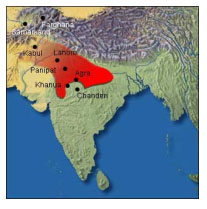
BABUR’S INDIA
HUMAYUN: (AD 1530-1556)
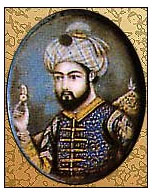
Nasir-ud-din Muhammad Humayun (AD 1508-1556), the eldest son of Babur ascended the throne in 1530 and ruled until 1540. He met defeat at the hands of the Afghan ruler Sher Khan Sur in 1540, at Chausa, between Varanasi and Patna. His army of 40,000 was defeated by a smaller army of 15,000 of Sher Khan Sur Humayun went into exile. He was given refugee in Persia by the Shah of Iran, Shah Tamasp. However, 15 years later he returned and regained the monarchy. His short rule of only 10 years was punctuated by conquests but no artistic or literary accomplishments. That privilege would fall in the hands of his descendants.
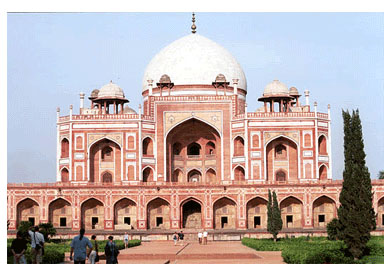
HUMAYUN'S TOMB (DELHI)
AKBAR THE GREATp: (AD 1556- 1605)
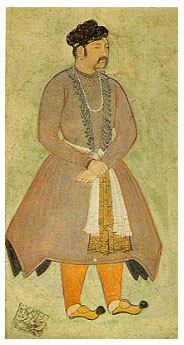
Akbar, the third Mughal Emperor was only 13 when he ascended the throne upon the untimely death of his father, Humayun. He ruled under the able guidance of Bairam Khan, a prominent nobleman and won a decisive battle against the Afghans. This, the second “Battle of Paniput” assured the continuation of the Mughal Empire. In 1562 Akbar took charge as the Emperor after he removed Bairam Khan from power.
For the next 30 or so years he concentrated on expanding the Empire, which meant he was constantly at war. However, when possible he used conciliation and reward for loyalty to gain control of Kingdoms and their land. He also followed an active program of involvement and amalgamation of the various kingdoms, especially of the warring Rajputs. Unlike most Muslim rulers he encouraged marriage between Hindus and Muslims. His favorite wife (first of 33 wives), was a Hindu Princess from Rajput. By the end of his campaign Akbar had extended his empire all across North India and Afghanistan as well as the Deccan in the south.
During the early part of his rule Akbar used Nagarchain, a village seven miles to the south of Agra. At the same time he had also revamped Agra by building over 500 masonry buildings. However, in 1571 he moved his capital to the newly built city of Fatehpur Sikri. A crowded metropolis during Akbar’s reign, this city fell victim to lack of planning and was abandoned when water shortage became acute.
Akbar is credited with building the Empire into one of the richest in World history and perhaps the wealthiest of the time. Besides his gift of conquests, he was a great administrator and with the conciliatory policies towards the no Muslims, he gained the loyalty of vast majority of his subjects. The liberal bend in his character is amply evidenced by his marrying two Hindu Princesses and then allowing them to practice Hindu religious ceremonies in the Harem.
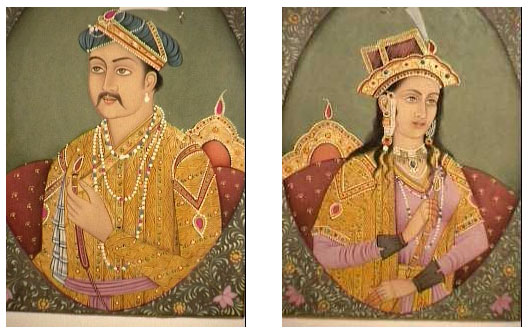
AKBAR AND HIS HINDU WIFE JODHBAI
Akbar’s greatest gift and genius was primarily military; thus he built an empire that would engulf almost the whole of India and Afghanistan. Most of the population of India (estimated at 140 millions) were his subjects; compared to this, the whole population of Europe was only 40 Million and that of England only 5 Million. His reforms in administration and taxation were also in part responsible for the sustenance of this vast empire. The abolition of the unpopular taxation of all but the wealthiest of the non-Muslims, his conciliatory gestures to Hindu rulers and even appointing them in senior posts in his administration further improved his credibility among the masses. Finally, his patronage of literature, the arts and music despite his own illiteracy and the balanced treatment of all religions ushered in a period of prosperity rarely matched in Indian history. While Fatehpur Sikri was abandoned as the capital city, its stunning architecture remains a fitting monument to this golden age of medieval India. The influence of Akbar and his successors spanned not only architecture and garden design but the Indian music and cuisine have been transformed forever. Is it any wonder why Akbar is celebrated as “The Great”, a distinction he shares with another Indian Emperor, Ashoka?
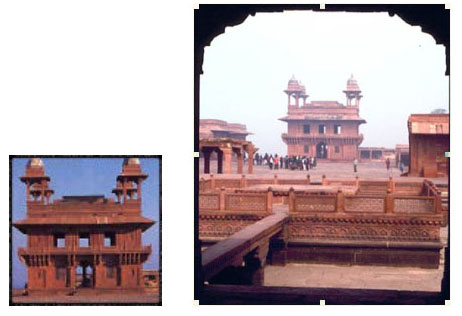
TWO VIEWS BUILDINGS IN FATEH PUR SIKRI
JAHANGIR: (AD 1569-1627)
Prince Salim was one of three sons of Akbar, of a Hindu Princess from Amber; the other two sons Prince Murad and Daniyal died early of excessive drinking. During Akbar’s long rule Prince Salim rebelled and exhibited impatience and a struggle took place with his father, the Emperor. Matters were also muddied by the fact that he (Prince Salim) had an affair with a court dancer (of “Anarkali” fame and the basis of the Hindi epic movie “Mughal-E-Azham”). When Akbar died in 1605, Prince Salim ascended the throne and proclaimed himself “The World Conqueror” or Jahangir. The battles for succession in this monarchy started when Salim’s own son Prince Khusrau also vied for the throne but Jahangir managed to prevail.
Unlike his father, Jahangir did not have much success in battles, especially in the Northwest although in the Deccan, his armies did defeat Malik Ambar. The task of dealing with Malik Ambar was left in the hands of his third and favorite son, Prince Khurram (later Emperor Shah Jahan). As a result of the able administration of Akbar the Mughal treasury had unlimited funds and both Jehangir and his son Shah Jahan could afford to spend large sums in constructing monuments and gardens. Much of the administration of the empire was left in the able hands of his wife Nur Jahan, her father Itimad-ud-daula and her brother Asaf Khan. Jahangir spent much of his time relaxing in the famous gardens he built in Kashmir. Unlike his predecessor, Akbar, or his successor Shah Jahan, Jahangir left no lasting relics.
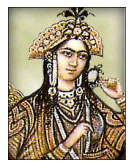
NUR JEHAN
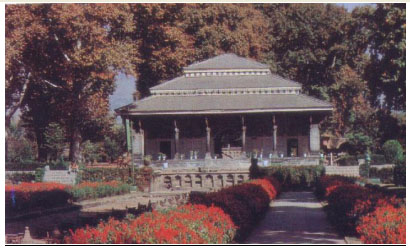
SHALIMAR GARDENS
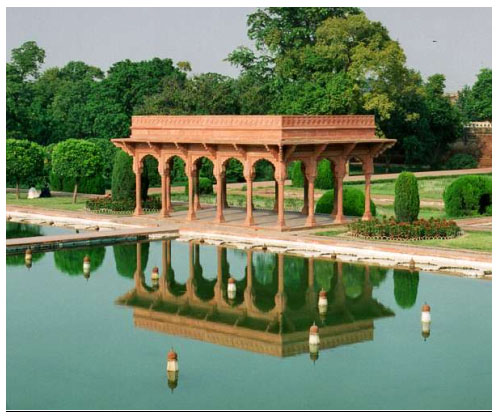
SHALIMAR GARDENS: (CE 1592-1666)
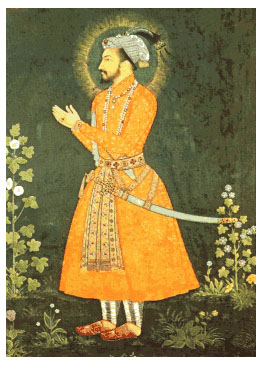
SHAH JAHAN
Like his father Jahangir, Prince Khurram was also born of a Hindu princess (Rajput princess Manmati). But unlike his father, there was tumultuous battle for succession between Prince Khurram and his brothers and his brother-in-law (Nur Jahan’s son-in-law) prince Shariyar. On ascending the throne Prince Khurram assumed the name of Shah Jahan (“King of the World”). Having inherited great wealth, thanks to the able administration of his grand father Akbar and to his aesthetic qualities, Shah Jahan set out to build great monuments.
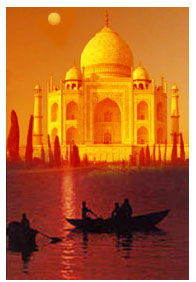
TAJ MAHAL AT SUNSET
Thus he built the black marble pavilion at the Shalimar gardens in Srinagar in Kashmir, white marble palace in Agra and a large city which he called Shahjanabad in Lahore. However, his greatest achievement was building the world famous Taj Mahal. It was built as a lasting monument to his love for his favorite wife and constant companion, Mumtaz Mahal (Princess Arjuman Banu who was the niece of Nur Jehan). He was devastated when Mumtaz Mahal died prematurely while giving birth to their fourteenth child. At her deathbed she asked Shah Jahan to build the most beautiful mausoleum. Once he recovered from the shock of losing her, the Emperor set out to build this lavish edifice. Please refer to the accompanying links to Taj Mahal for details and more pictures. Shah Jahan also built the Juma Masjid and renovated forts in Delhi and Agra. After he was imprisoned by his third son Aurangzeb as a part of his battle for succession, Shah Jahan was kept prisoner in the Agra fort for the last eight years of his life. From there he could gaze at the Taj Mahal. In 1666, at the age of 74, Shah Jahan died and was laid to rest next to his wife.
During his reign Shah Jahan did manage to extend the empire to the Deccan. However, his conquests to Afghanistan were quelled by the Persians in Kandahar. Thus the lasting legacy of Shah Jahan was architectural and not the size of the empire or any philosophical or literary achievements, unlike his grand father Akbar.
AURANGZEB: (AD 1618-1707)
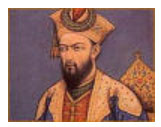
Aurangzeb was acting as Governor of Deccan at the time the power struggle for succession to the throne of the Mughal Empire began. His father, Emperor Shah Jahan preferred the first son, Prince Dara Shikoh. The latter had shown great promise to carry on the enlightened path of his great grandfather, the great Akbar. His potential was amply revealed by him translating the Hindu Upanishads into the Persian language. However, he would turn out to be less able in the battle for succession and Aurangzeb marched from the Deccan, killed all his challengers and ascended the throne.
After dispensing of all opposition, Aurangzeb imprisoned his father whom he kept for eight years under house arrest in the Agra Fort. There, Shah Jahan took solace in the fact that he could gaze across the Yamuna River, at the spectacular monument he built for his beloved wife Mumtaz Mahal. Aurangzeb systematically dismantled every gain that his predecessors did in ruling a predominantly Hindu India with diplomacy and conciliation. Thus, during his reign the vastly unpopular taxation system whereby non-Muslims were taxed (“jizya”) was reinstated. Hindu temples and traditions were systematically destroyed with the hope of converting the whole of India into an Islamic state. Where the holiest of Hindu temples were desecrated and destroyed, Aurnagzeb built Muslim mosques. His long reign was bereft of any lasting monuments or architectural achievements that were the hallmarks of the Mughal rulers from Akbar’s time onwards.
For over 27 years and until his death Aurangzeb was bogged down in battles in the Deccan. Much effort went into subduing the Marathas who were under the cunning leadership of Shivaji. With able administration and with shrewd military conquests Aurgangzeb extended the empire into Tibet and Assam. But as history would record, through his bigoted actions Aurangzeb presided over the moral demise of this once great empire. In 1707 at the age of 90 he died and another bitter struggle for succession ensued. The victor, Prince Muazzar assumed the name of Bahadur Shah and ruled over the dwindling empire. The last Mughal king was Bahadur Shah Zanfar II who was dethroned in 1858 and the British era began.
USEFUL LINKS:
1) www.indianest.com/history/009.htm
2) www.indhistory.com/akbar.html
3) www.kamat.com/kalranga/mogul/akbar.htm
4) www.ignca.nic.in/agra037.htm
THE DECLINE AND FALL OF MUGHAL EMPIRE
By Baba Vickram Aditya Bedi
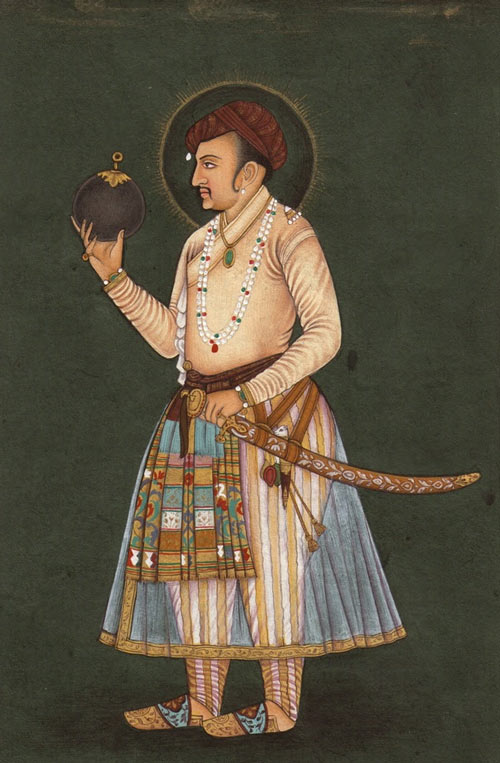
Emperor Jahangir
The decline of the Mughal Sultanate began not because of economic reasons, nor because the ruling class established in Hindustan, lost loyalty. The end of the Third Golden age of Indian history came because of the antithesis of the processes which led to the creation of the Mughal Empire. The Mugual Empire began when Mohammad Babur won the battle of Panipat in 1526. His direction of rule was initially similar to what had been the standard pentameters since the Islamic Invasions of India had begun in earnest after the year 1000. But, things were politically quite different in India in 1526. Two very distinct personalities had created movements which attracted for the first time, Hindu and Muslim interest and joint fellowship. Baba Guru Nanak Dev Ji, was not just considered a Saint and founder of the Sikh Movement by the Hindu community of North India, but also by a large contingent of Muslims as well. On the other side of the spectrum, Sant Kabir also had a attracted both Hindu and Muslim fellowship. The fact that Baba Nanak and Sant Kabir embraced the concept of inclusion to such an extent created a environment where Babur’s actions were openly criticized. Baba Nanak, would not hesitate to do this publicly, and in fact he even wrote about the terror that Babur was inflicting on North India. Thus, Mohammad Babur could not simply continue the pattern of the Afghani and Turkish invaders before him, an age of secular resistance had evolved in India to the Sword of Islamic invasion.
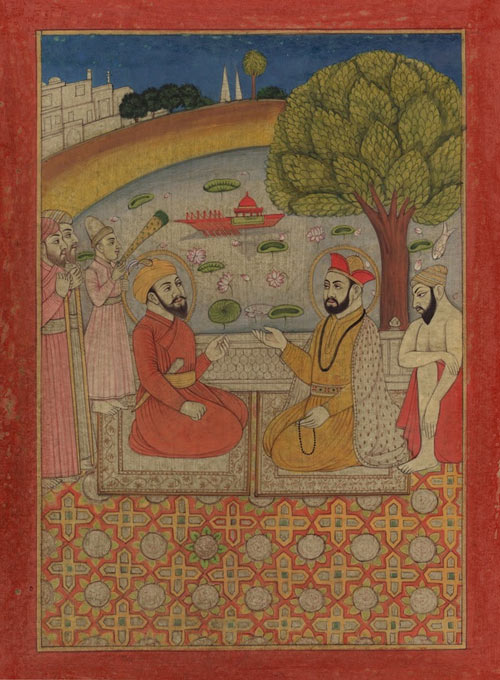
Baba Guru Nanak Dev Ji and Emperor Mohammad Babur
Mohammad Babur became a true Emperor after his meeting with Baba Nanak, for he grasped the concept of “Just Rule” and “Tolerance”. He realized that India could not be governed by the rule of oppression and forced conversion. For this would create nothing more than ultimate civil war. Today, many in India look at Babur as an intolerant ruler. And the basis for this is because the history which was created during 190 years of colonial rule in India. Yes, Babur was an invader into India and initially he disliked all things Indian. He waged war to defeat the Lodhi Dynasty, inflicted causalities. Babur did immediately pledge to rebuild Delhi and he began this process even before his great change of personality. Emperor Babur would eventually embark on path that most Indian rulers did not before him, he would look beyond caste, and religion. In his ultimate will and testament known as the Wasyaat Naama to his son Hamayun, he would state the following principles:
- A ruler had to stay clear of any religious prejudice and keep in mind the religious and cultural sentiments of all the people being governed. This was a direct inclusion of the principles of Baba Nanak, into his vision for the future.
- There was no productive role a ruler could have other than to stay out of religion and disputes based on religion. The concept of remaining Neutral was emphasized.
- A ruler must be able to predict if tensions will increased because of Official Policy. Thus, he suggested and really demanded that Hamayun, ban Cow Slaughter in his Empire. As the outrage sparked by the practice outweighed any benefit.
- A Monarch had no justification to destroy places of Worship. In fact he had an obligation to protect all places of Worship to avoid hostilities in his nation. In fact his only commitment was to the maintenance of peace.
- Babur even spoke of that role Islam should play. For him any real engagement it could have with other religions had to be based on peaceful interchange and not the Sword. He went on state that even “Dirty Politics” was not acceptable to spread Islam. As religion had to be kept separate from the working of the state.
- Mohammad Babur went on to address the need to look at linguistic and ethnic diversity as “Seasons of the Year” there had to be seamless cohesion for them. And tolerance was the only way to accomplish these goals.
This aspect of Babur’s later rule is not formally taught in the educational system and it is because of the lasting impact of Colonialism. The truth of Babur did not suit colonial interests. For it was far better to depict the founder of the Mughal Dyansty as a tyrant, rather than a person who changed course in the middle of his rule and became enlightened. For the actuality of Babur is this, and he cultivated a relationship with Baba Nanak. This shows that Babur became more humane than the British Empire in India ever did, and that he had capacity to do so. The rise of his Grand Son, Emperor Abkar, actually was an evolution of this direction. The Navratan Court’s reforms of 1580 were also an aspect of Indian National History which is more or less swept under the rug. As these reforms were the culmination of the Bakhti age, and it’s incredible translation of humanism into legal decree. The fact is that Emperor Akbar continued the school of reasoning which combined Vedic thought and Sufi practice.
Emperor Akbar had immense desire to understand the spiritual world, and to implement change in society which he believed came from this “Logic” which was inherent in the make up of the Universe. Baba Nanak, had stated clearly that even an attempt to describe the force of creation was not possible “For if the oceans were ink, then, they would run dry of ink before even beginning to describe him.” In this age where Europe had an active inquisition and people were burned on the stake. Secular Humanism, was understood by Emperor Akbar as the only viable path for the State to take. In 1583, Emperor Akbar would write a letter to King Phillip the II, of Spain. In this letter Emperor Akbar would outline that religious intolerance to Protestants, Jews and Muslims was not the way forward. He would state, “As most men are fettered by bonds of tradition, and by imitating ways followed by their fathers… everyone continues, without investigating their arguments and reasons, to follow the religion in which he was born and educated, thus excluding himself from the possibility of ascertaining the truth, which is the noblest aim of the human intellect. Therefore we associate at convenient seasons with learned men of all religions, thus deriving profit from their exquisite discourses and exalted aspirations.” In a separate letter to his son Prince Salim, he would state as such ““We were sent into the world by providence to live and labor, not for oneself but for others.”
These principles would give rise to the Third Golden age of India beginning in earnest after 1580. India’s economy would regain the status of the World’s Largest by 1605. This would continue for the next 157 years. But, the rule of intolerance slowly crept back and then returned full scale during the rule of Emperor Aurangzeb. A major factor often over looked by historians is that, the long bigoted rule of Aurangzeb was only possible because of the prosperity level of India at this time. Had India not been the largest economy in the world, Aurangzeb could never have waged war for most of his rule, nor could he have afforded to implement disastrous polarizing polices without having civil war breakout. Even with this reality, the ruling Elite of India, which included Muslims and Hindus, decided that the policies of division were reducing the tax revenue. And they began to implement their own policies which were in contrast to Emperor Aurangzeb's. These of course were in the beginning very small variants of official policy and in many cases did not really stop the polarization of Indian Society. Yet, they were starting down a road which they could not come back from. The Mughal Vassals, did not start out this way to end the Mughal Sultanate as they depended on it’s institutions for global trade, and security.
Emperor Aurangzeb on his death in 1707, left an Indian-Subcontinent which was United from Afghanistan all the way South to Golkunda. It was the largest any Indian Empire had been since the time of Emperor Ashoka. Yet he had planted the seeds of decline, and created two rebellions which could not be contained, these were the Sikh and Maratha movements for self-rule. The vassals in the Mughal Empire saw the weakening of Central Control and the complete swing back in policy under Shah Alam as a sign of how wrong things had really gone. They did not want to be drawn into such a climate again, and wanted to created a slight separation from central control. These Mughal Vassals not only stopped sending their share of collected tax to the center, but also began to reduce their large standing armies. They failed to see that trade would begin to breakdown if this process continued. So India became more reliant on the British East India company which facilitated trade by sea, and less connected to inner Asia. The chain effect was devastating for the the Mughal Military. In 1738, Nadir Shah or Iran would take advantage of this situation and invade India. He would sack Delhi for three weeks and take back the most prized possessions of the Mughal Sultanate including the Peacock Throne.
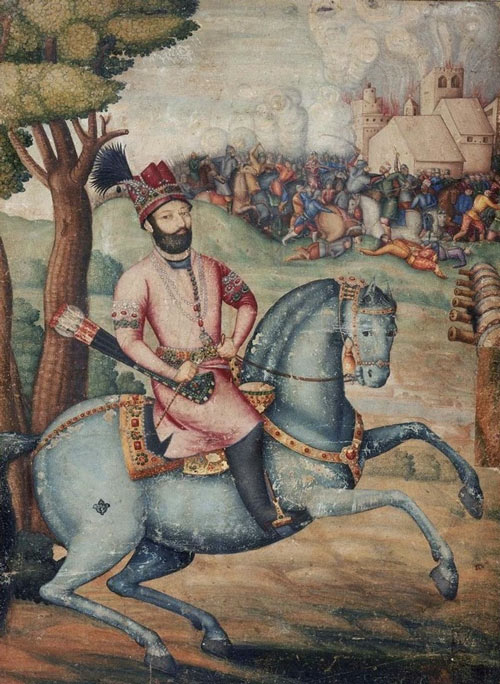
Nadir Shah attacks Delhi 1738.
Even so the Mughal Empire would continue, and this was only because of it’s past prestige. But it was no longer a force which could defend India from invasion of any kind. The days were gone when it could defeat even the preeminent Western power England, such as it had done in the 1690’s in Child’s War. The decline of the Mughal Sultanate was increasing quickly in mid 1700’s. The most incredibly sad aspect to this was, that those aspiring for regional independence did not realize that they were actually going to loose far more through their actions. For in effect they were paving the way for Western Colonialism. The British East India company had been for more than 100 years been forced by the Mughal Administrators to pay for Indian goods in Gold or Silver. India hardly imported anything from the West. India was the largest exporter in the world, and this trade imbalance was not looked at with favor in England. They had tried unsuccessfully to gain a foot hold in India militarily in Child’s war and had been forced to surrender in a most humiliating way by Emperor Aurangzeb. The British had begged to keep their trading rights. And had the situation had not changed in their favor in India, the British had in the early 1700’s come to the the conclusion that they simply could not challenge the Mughal war machine which was largest standing land Army in the world. In fact Mughal India, was the largest single producer of ships, muskets, rockets and long range cannons in the world in the 1690’s.
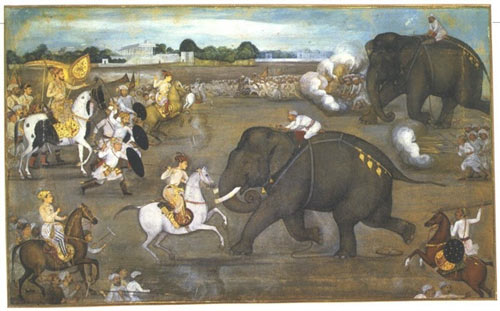
This British familiarity with India, was a double edged sword for the future of India. As the Mughal Sultanate lost Central Control of parts of India, the Subah of Bengal become an easier target for internal strife. Seeing this, the British now waited for their moment to enter Indian Politics and end the payment for Indian manufactured goods. For on June 23, 1757, the Mughal Vassal Mir Jaffar decided to deliver victory for the British in the Subah of Bengal. Suddenly 12% of global G.D.P. was handed over to the British in the form of the wealthiest province of Mughal India. A contingent of barges more than 7 miles left Bengal for England, and the accumulated capital surpluses of over 200 years of trade were lost for India. It can be stated that the industrial revolution which began in 1760, was paid for by Indian capital, India was plunged into a darkness of defeat which would not end until 1947. The British East India company began to de-industrialize the Subah of Bengal. Skilled workers had their fingers cut off. Agricultural output decreased rapidly. The Mughal policy of food production being supported by taxation policy was ended. The building of irrigation projects stopped. Instead began British taxation ,which created landless peasants for the first time in Indian History. The regulation of Interest rates ceased. Finally Opium was begun to be grown instead of food, and the final Mughal Policy of not allowing the cultivation of such narcotics on mass scale was ended. The British flag would slowly come to fly over more and more parts of India. Famine, Poverty and racial discrimination would follow. Mir Jaffar would spend the rest of days hiding, he became known as one the greatest traitor’s in Indian National History.
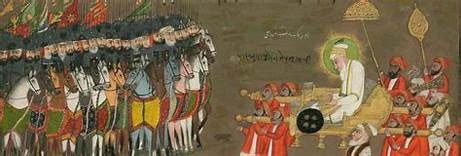
The Ruling of Class of the Mughal Sultanate would never have begun the process of disengagement from the Center, had not rule of Aurangzeb come about. In fact Shah Jahan had stated clearly that he desired Prince Dara Shikoh to become Emperor following his rule. He even gave support to Prince Dara Shikoh to win the War of Succession. In every way possible way Dara Shikoh would have been a far more tolerant ruler. He was compared in intellect to Emperor Akbar. Dara Shikoh had Indian Epics translated into Persian so that they could be understood by the Royal Court. He had a close relationship with Guru Har Rai. Dara Shikoh saw the oneness of all religious paths and for him the rule of philosophy was the center of progress. It is very likely had he come to the throne, the history of India would be different today. Aurangzeb, would imprison his own father and have his brother Prince Dara Shikoh executed in front of his young son. Thus, Aurangzeb lacked any sense of family in addition to his rule of hostility.
Though by following the historical rules of actuality, the Mughal Elite became the indirect reason for the decline of Mughal India. The real impetus were the policies and lack of positive leadership qualities by Aurangzeb. The Mughal Sultanate had grown because of the reforms of Emperor Akbar and not because of the advanced military technology Aurangzeb. The Mughal Sultanate had grown because of the reforms of Emperor Akbar and not because of the advanced military technology they possessed. The economic resources which had been created by the Empire were misused by Aurangzeb to conquer the rest of of India by force without seeking cooperation and inclusion. His expansion had been too rapid to sustain. The creation of rebellion and discontentment in all segments of society, which the provinces could not even attempt to control without separating themselves from the Central Power Base, would create the quick course for the end of Mughal Authority. Eventually, these provinces set in motion a path which could not be reversed. To make the situation worse than it was already, Nadir Shah took away any semblance of the invincibility which once had been a Mughal Hallmark in India. The final act was seizure of the Subah of Bengal by the British in 1757, which crippled Indian efforts to use Indian Capital to modernize Indian military capabilities. All hope of any Mughal Significance was lost. The Sikh and Maratha rebels would succeed, and the Mughal Sultanate would become a Maratha protectorate, until the British would defeat the Maratha Empire. After the First War of Indian Independence, the last Mughal Emperor Bhadur Shah Zafar would endure a Sham Colonial Trial. His son’s would be murdered in cold blood by an ordinary British Officer, and his possessions would be looted by Colonialism. He would perish in prison in Rangoon. Thus ended the third golden age of Indian National History. An Empire which had achieved so much, which had made Hindustan the world’s first Secular State and the largest economy in the world once more, would end in such a tragic way. Emperor Bahadur Shah Zafar statedi,क “ तना & बदनसीब "ज़फ़रʺ द.न /िल ए दो गज़ ज़मीन भी िनम ली क7-ए-यार 9” Which translated means, “How unfortunate is Zafar, for his burial not even two yards of land were to be had for his burial in his beloved land (Hindustan).
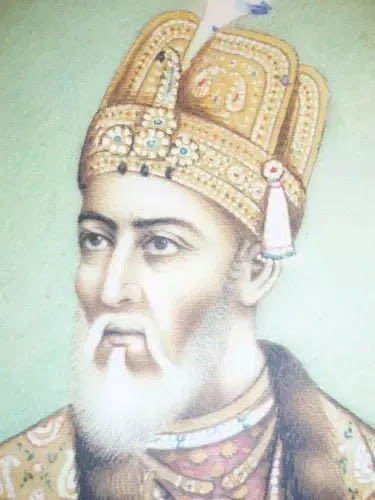
Bhadur Shah Zafar the last Mughal Emperor
Akbar’s letter to King of Spain for religious tolerance