NORTH AND SOUTH INDIAN CLASSICAL MUSIC
by David Courtney, Ph.D.
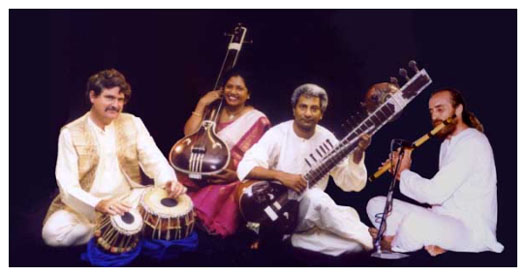
NORTH INDIAN CLASSICAL MUSIC (HINDUSTANI SANGEET)
The classical music of North India is known as Hindustani Sangeet or sometimes as Hindusthani Sangit. It is found in an area that extends
roughly from parts of Afghanistan and Pakistan into northern and central India and as far east as Bangladesh.
Hindustani Sangeet is usually considered to be a mixture of traditional Hindu musical concepts and Persian performance practice. There is some merit in this view, but it is probably an oversimplification.
There are many musical instruments that are associated with Hindustani sangeet. The most famous are the tabla and sitar. Other less well
known instruments are the sarangi, santur, and the sarod.
HISTORY OF NORTH INDIAN MUSIC:
North Indian classical music sprang from an amalgamation of musical influences from India and the greater Islamic world. Northern India
began to feel the influence of these foreign invaders from the time of Mahmud Ghazani (11th century) and finally culminated in a sustained
presence with the establishment of the Khilji dynasty (13th-14th century). The religious roots of the new rulers made them more interested in affairs of the greater Islamic world than that of the local Hindu population. This created an environment that mixed the local Indian music with the music from Persia, the Caucus, and other parts of the Islamic world.
One of the the most notable of the early artists was Amir Khusru (1254-1324A.D.). He was born in India, but his father was from Turkey. Amir Khusru became famous as a poet, musician, composer, as well as a diplomat. His reputation became so great that even today, he is
credited (usually erroneously) with the invention of most of the things which characterize North Indian classical music.
In the next few centuries, many of the technical characteristics of North Indian music crystallized. Many of the rags and tals that are used today are traceable to this period. Even some of today’s genres are traceable to this period.
The period of Akbar the Great (born 1542-died 1605)is considered to be a high point for North Indian music. One of the most notable personages of this time was a musician and composer known as Tansen. A very large number of today's rags are credited to him. Tansen’s stature as a musician was so great that it is said that he could create miracles by his singing.
The period of Aurangzeb (born 1618 died 1707) is generally considered to be the nadir for North Indian music. Aurangzeb was a fundamentalist who considered music to be contrary to the tenets of Islam. On one occasion, the populace held a protest by presenting a mock funeral where the participants declared the ”death” of music, whereupon Aurangzeb is reported to have declared “bury it deep”.
It may have been a difficult period, but it was a necessary one for the development of the music! The collapse of the Mughal empire with
accompanying disruption in social and economic systems, may have been hard for the musicians, but it did “clear the field” to allow the
emergence of many new musical genres. Many of these new genres are considered to be the cornerstone of today’s musical practice.
The 17th-19th centuries saw the emergence of many new genres. The kheyal form of singing was one. The musical interpretation of ghazal is
also noteworthy. Dance forms such as kathak, also assumed their modern form.
The late 19th and early 20th century was another transitional period. Although there were relatively few changes in rags, tals and musical
genres, there was a major shift in the social position of musicians and dancers. Earlier, these artists were in a questionable social strata,
but things got even worse. By the turn of the 20th century, musicians were considered to be little more than pimps and prostitutes. However,
with the emerging independence movement, there was an urgent need to unite the disparate South Asian communities with some sense of national identity. The Hindustani system of music and dance was particularly important in helping forge this sense of commonality among North Indians.
There was a very curious wrinkle in the development of North indian music in this period; it was undergoing a social bifurcation. In the
events leading up to Indian independence, music became a tool for creating a sense of national identity, but in Pakistan it did not.
This had a curious effect upon North Indian music and musicians.
India showed profound changes in the relationship of music and musicians to society. Music and dance began to shed its stigma and
began to assume a middle and upper class connotation. The music became more formalized and “scientific” in its approach. The educational
level of its practitioners rose sharply.
However, musicians in Pakistan felt no appreciable boost in their social position; if anything, musicians became even more marginalized
than before and thus maintain a low-class stigma even today.
It is remarkable to realize that the same musical system could diverge so fast in so short a time. The classical music in Pakistan tends to
be unrefined and its musicians stigmatized while the same music is exalted and formalized in India and its musicians respected.
MUSICAL CHARACTERISTICS:
There are some interesting musical characteristics for North Indian classical music. These will be seen in the concepts of scale structure
as well as in the concepts behind the rhythmic patterns.
Scale Structure - The north Indian approach to the scale is conceptually similar to the Western concept. In this approach, there are 12 semitones, from which our seven notes are derived. Their names and positions are shown below.
Long name/Short form
------------------------------------------------------
1. Shadaj /Sa
2. Komal Rishabh /Re
3. Shuddha Rishabh /Re
4. Komal Gandhar /Ga
5. Shuddha Gandhar /Ga
6. Shuddha Madhyam /Ma
7. Tivra Madhyam /Má
8. Pancham /Pa
9. Komal Dhaivat /Dha
10. Shuddha Dhaivat /Dha
11. Komal Nishad /Ni
12. Shuddha Nishad /Ni
There are several interesting points shown in the previous table. One point of note is that the 1st (shadaj) and the 5th (pancham) have no
alternate form. In India, the the first and the fifth are said to be “achalla”, meaning that they cannot be moved. All of the others have alternate forms. A natural note is referred to “shuddha” while a flattened note is referred to as “komal”. The fourth (madhyam) is notable in that there is a natural (shuddha) and an augmented or sharpened form (tivra).
It is interesting to note that the “natural scale” in North India is the same as the Western natural scale. However, one should not presume
that this scale has any special popularity. Its designation as “natural” appears to be merely a convenience for musical notation and musical theory.
This may clarify some of the issues behind the North Indian scales, but what about the rags?
Rags: North Indian rags have an ascending and a descending structure. In other words, the notes (mode) when going up the scale,
need not be the same as the notes (mode) when coming down.
North Indian rags have a time-of-day attached to them. This is a peculiarity of the North Indian interpretation. South Indians rags are
not attached to any particular time.
There may also be a characteristic phrase. This phrase is variously referred to as “pakad” or “swarup”. Such a phrase can make the
character of the rag very easy to recognize.
Additionally, there is a concept of importance of the notes. According to this system, an important note is referred to as a vadi, while a
note of secondary importance is referred to as samvadi. This system is conceptually quite simple, but the implementation has been so poor that this concept may safely be discounted.
The Tal: The North Indian approach to rhythm has some unique features. Although the basic structure of beat/measure/cycle is fundamental to
the tal, there is the addition of one unique concept, the theka.
The theka is a conventionally accepted pattern of bols (syllables) which are used to define the tal. In the North, one may have multiple
tals with the same number of beats, the same number of measures and with the same clapping and waving arrangement; yet they may be
considered to be separate tals if the thekas are different. This is not the case in South Indian music.
VOCAL FORMS:
There are many vocal forms in North Indian classical music. Here is a small list:
Kheyal: The kheyal is a highly improvised form of music. It has its origins in the 17th-18th century and has grown steadily in popularity.
Today, it is considered the benchmark for North Indian classical music. There are generally two movements; there is a slow section known as
bada, or vilambit kheyal, there is also a fast section which is known as chotta or drut kheyal.
Tarana: Tarana is said to go back to the time of Amir Khusru (circa 1300a.d.). Originally the lyrics were in Persian, but over the centuries the words have devolved into meaningless syllables. Today, it is a form which is roughly comparable to the Western scat singing.
Dhrupad: At one time, the dhrupad was considered to be the standard for North Indian classical vocal. However, during the 20th century it
declined in popularity until today it is nearly extinct.
Dhammar: Dhammar is considered to be a somewhat lighter form of dhrupad. It is also known as hori, or holi, due to its association
with the springtime festival of the same name.
Semiclassical Music: There are also a number of semiclassical forms of music. Tappa, thumri and even ghazal are often considered to lie
within this class.
The ghazal deserves particular note. It was originally not a style of singing at all, but a recitation of poetry. But over the last hundred years, it has become more musical until today it is generally considered to be a semiclassical form of song.
MUSICAL INSTRUMENTS:
There are a number of musical instruments which are common in North Indian classical music. Tambura (tanpura) sitar, sarod, santur,
sarangi, shehnai, tabla and pakhawaj are the main ones. These will be discussed in greater detail elsewhere.
CARNATIC SANGEET
THE SOUTH INDIAN SYSTEM OF CLASSICAL MUSIC:
Carnatic sangeet (karnatik sangit), is the South Indian system of classical music. It has a rich history and a very sophisticated system of theory. The composers and performers have gained a world class reputation by singing and playing instruments such as, violin, gottuvadyam, mridangam, and veena (vina).
Carnatic Sangeet is found in the south Indian states of Kerala, Tamil Nadu, Karnataka, and Andhra Pradesh.
RELATIONSHIP BETWEEN HINDUSTANI AND CARNATIC SANGEET:
The reasons for the distinction between South, and North Indian music is not clear. Most people feel that North Indian music evolved along
different lines due to an increased exposure to the Islamic world. This results from nearly eight centuries of Islamic rule over the North.
Unfortunately, evidence suggests that this is a gross over-simplification. For instance, Kerala has an extremely large Muslim population, but virtually no identification with the music of northern India. In a similar way, the Islamic influence in Orissa was negligible, yet the artistic forms show a strong connection with North Indian music. There is a poor correlation between the geographical distribution of Hindus and Muslims and the two systems of music; but there is an almost exact correlation with the distribution of Indo-European/Dravidian cultures.
Therefore, we come to the politically uncomfortable, yet inescapable conclusion that the differences between South and North Indian music
does not represent a differentiation caused entirely by Islamic influence. The two systems instead represent fundamental cultural differences between north Indians and South Indians.
Nomenclature - The system of nomenclature is very different in North and South Indian music. It is normal for a particular rag or tal to be
called one thing in the North and something totally different in the South. It is also common for the same name to be applied to very
different thalams and ragams.
HISTORY OF CARNATIC SANGEET:
We can begin our discussion of the history of Carnatic Sangeet with Purandardas (1480-1564). Most consider him to be the father of
Carnatic Sangeet. He is given credit for the codification of the method of teaching, and is also credited with several thousand
compositions.
Venkat Mukhi Swami (17th century) was also very influential. He was the one who developed the melakarta system (the system of categorizing
South Indian rags).
Carnatic music acquired its present form in the 18th century. It was during this time that the "trinity" of Carnatic music, Thyagaraja, Shamashastri, and Muthuswami Dikshitar composed their famous songs. In addition to our famous trio, numerous other musicians and composers enriched this tradition. Some notable people were; Uttukadu Venkatasubbair, Gopala Krishna Bharati, Swati Tirunal, Papanasam
Shivan, Mysore Vasudevachar, Narayan Tirtha, Arunagiri Nathar, and Annamacharya.
CARNATIC MUSIC THEORY:
Carnatic music has a well developed theoretical system. It is also based upon a system of ragam (rag) and thalam (tal). These describe the
intricacies of the melodic and rhythmic forms.
The melodic form is the ragam (rag). Ragam (rag) is based upon the scale. The seven notes of this scale are Sa, Ri, Ga, Ma, Pa, Dha, and
Ni. However, unlike a simple scale, there are certain melodic obligations and restrictions. Each ragam (rag) has a set way that it moves from note to note.
The South Indian scale is very interesting. It allows chromaticisms that one simply does not find in either Occidental or North Indian
music. The South Indian scale may be conceptualized as 12 semitones with the following significance:
1 - Shadaj
2 - 1st position Rishabh
3 - 2nd position Rishabh or 1st position Gandhar
4 - 3rd position Rishabh or 2nd position Gandhar
5 - 3rd position Rishabh or 3rd position Gandhar
6 - 1st position Madhyam
7 - 2nd position Madhyam
8 - Pancham
9 - 1st position Dhaivat
10 - 2nd position Dhaivat or 1st position Nishad
11 - 3rd position Dhaivat or 2nd position Nishad
12 - 3rd position Nishad
The ragams are categorized according to various modes. The chromaticisms that are allowed greatly increase the possible number of
modes; there are 72 in all.
Thalam: The rhythmic foundation to the system is known as tal (thalam). The south Indian thalams (tals) are defined by a system of clapping and waving of the hands. This system of clapping is much less important in the north, where the tals are defined by a conventionally
established pattern of strokes on the tabla.
PERFORMANCE:
Vocal music provides the foundation for South Indian music. Although there is a rich instrumental tradition that uses venu (bamboo flute),
Veena (a large stringed lute) and violin; they revolve around instrumental renditions of vocal forms.
There are a number of movements to the Carnatic performance. Varanam is a form used to start many south Indian performances; the word
varanam literal means “a description” and this section is used to unfold the various important features of the ragam. The kritis are fixed compositions; they have well identified composers and do not allow much scope for variation. Such compositions are often preceded by alapana; the alapana offers a way to unfold the ragam to the audience, and at the same time, allow the artist considerable scope for improvisation. The kalpana swara and the niruval also provide opportunities to improvise. Another common form is the ragam, thanam, and, pallavi.
South Indian performances are based upon three major movements. These are the pallavi, anupallavi, and charanam. These roughly correspond to the sthai, antara, and the abhog in North Indian Music.
CARNATIC MUSICAL INSTRUMENTS:
There are a number of musical instruments used in South Indian classical music. Here are some of the more common ones. The most
common ones are the veena (vina), violin, mridangam, nadaswaram, and the tavil.
CONCLUSION:
The rich tradition of South Indian music is one of the world’s gems. The high performance standards and the well organized theoretical
foundation put it on par with anything that world has seen, East or West!