T A X I L A
(TAKSHA-SILA)
(Currently situated 40 Km NW of Rawalpindi, Pakistan)
“A land of rich harvests, flowing streams and fountains, abundant flowers and fruits”
As stated by the Chinese scholar Huen Tsang
In the history of ancient India, the names Taksha-sila and Nalanda hold a special place. Those of us who grew up in India, had been aware, even in our primary school dates, of the fact that both places were great seats of learning and both attracted students from all over India and most of the rest of Asia. Thus, one can easily make a justifiable comparison of Nalanda and Taksha-sila with the modern equivalents Harvard, Oxford and Cambridge; in fact, both were forerunners of the modern universities. However, Taksha-Sila (Taxila, the name given by the Greeks and which most people now use) was much more than a hallowed place of learning; situated as it were, in the crossroads of Greece and Persia in the West and Mongolia and China in the East, it was also a seat of commerce and cultural intercourse. So, one can only imagine what the city was like during its Golden Age. And, after almost two millennia of decomposition, a visit to Taxila evokes strong feelings of melancholy. One can, however, take solace in the fact that the fate that befell both Taxila and Nalanda is unlikely to take place in the modern centers, as systematic destruction by invading hordes is a thing of the past (with the exception of what the so-called "Caliphate" (the name assumed by quasi-military operations carried out by the "ISIS" or "Islamic State") is doing in Iraq and Syria in the Middle of the second decade of the 21st Century. They have destroyed relics of the old civilizations in both Syria and Iraq, which, for antiquity boasted irreplaceable historic and cultural buildings and artefacts).
Taxila and the other capital city Purushapura (modern Peshawar) were both seats of government and learning in the Gandhara kingdom. The other areas in this region are Dir, Swat, Bajaur and Bunair. The Gandhara region is in present day Afghanistan. The story of Taxila, which was the capital of Gandhara region of ancient India, can be divided into three separate time periods and cities:
AERIAL VIEW OF TAKSHA-SILA UNIVERSITY (TAXILA)

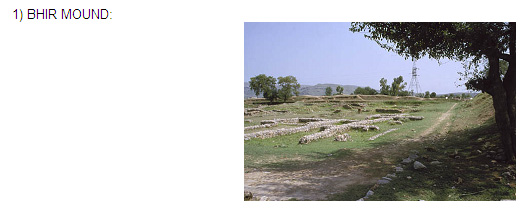
Legend holds that the city of Taxila was founded by a son of Rama’s brother (Rama is an Avatar of Vishnu, the Hindu God, and the hero in the great Hindu Epic "Ramayana"). Also, it is rumored that the other Hindu Epic Mahabharata was first recited at Taxila. While the city was situated in a strategic location along the Silk Road and under the influence of Greece and Persia in the West and China and other East Asians’ influence, the city itself was apparently not well-planned. The buildings were built with stone that was plastered with mud. There were no wells and, water for all purposes was obtained from the rivers. There was a network of open drains, but the streets were badly paved, without much planning. This is rather surprising as the Indus Valley Civilization in Mohenjo Daro and Harappa, which was much earlier, had grid-like patterns of streets and plumbing as well as planned sewage systems. On the Western part of the city is the “Pillared Hall”, purported to be a place of worship. This is regarded as the earliest Hindu shrine.
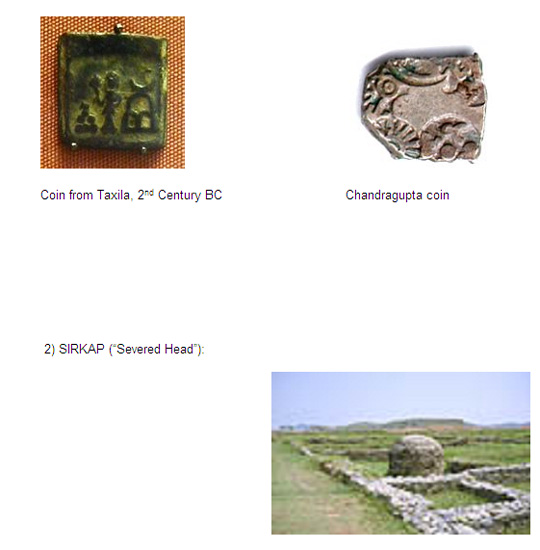
At the time of Alexander the Great’s invasion (326 BCE), Taxila was already a flourishing center of commerce and culture. After Alexander’s departure and the accession of Taxila into the Mauryan Empire of Magadha, it had a resurgence of importance. Particularly during the reign of Emperor Ashoka the Great, Taxila became a great center of Buddhist learning. He built two new Buddhist monasteries to the east of the city; the Dharmarajika monastery where several relics of the Buddha were buried, remains the more important of the buildings, especially the Stupa. In the monastery are a series of small chapels where monks meditated. Also found in this monastery were coins (both gold and silver), gems and other jewelry, some of which are shown below:
After the Mauryan influence waned, the Bactrian (descendents of the Greeks) ruled Gandhara from the new capital at a site called Sirkap. The buildings and roads were fashioned after Greek tradition and were much better planned. In order to protect the city from invaders, the Bactrian kings built a stone wall 6 meters thick and stretching 15 Km. Within this wall can be found several temples and monasteries. Examples are Apsidal temple, Sun temple, Shrine of the Double-headed Eagle, Kunala monastery and Ghai monastery. Another important complex of chapels and Stupas is called Jauvian. There are beautiful reliefs of the Buddha,
Bodhivast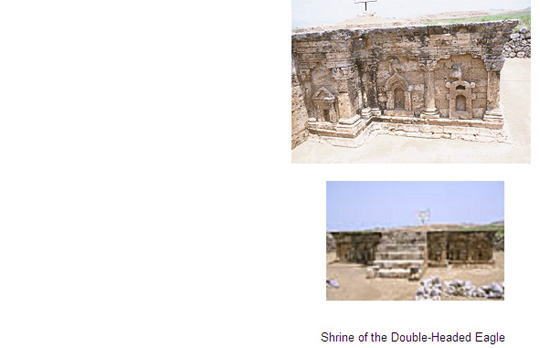
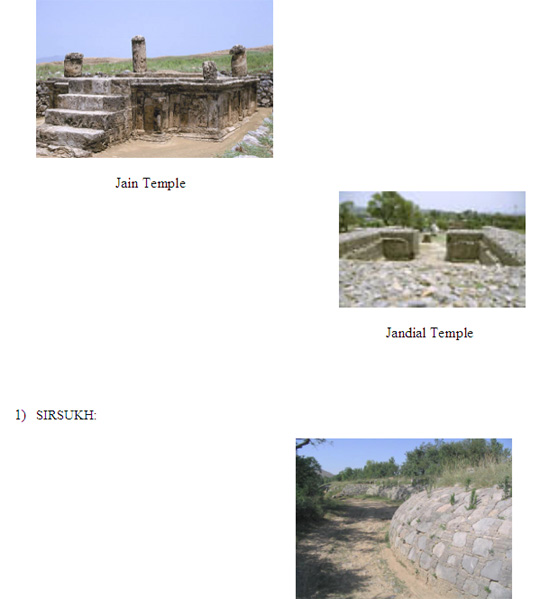
This is the third and last site where Taxila was built and flourished. After the Bactrian’s, invading nomads from Central Asia called the “Yuezhi nomads” established a kingdom in Taxila even farther to the north. This town was called Sirsukh and formed the capital of the Kushan dynasty from 75 CE to 230 CE. Kushan dynasty encouraged both Buddhist learning, and commerce and Taxila found a resurgence and experienced another Golden Age. Trade between the Romans and the Greeks, as well as the rest of Asia, led to great increase in wealth and influence of Taxila once again. However, with the invasion by Huns and destruction of the education and Buddhist centers of Taxila, the final downfall of the city occurred and it never recovered.
CONCLUSION:
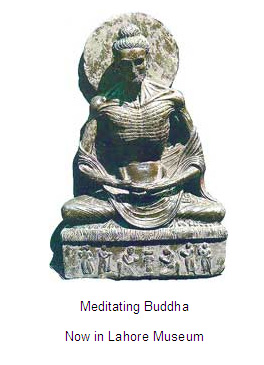
At the time of Indian independence from Britain, Taxila, as did the Indus valley centers Mohenjo-Daro and Harappa, as well as Purusha Puram (the capital of the other ancient Gandhara kingdom, (modern Peshawar)) became parts of Pakistan. It is heartening to note that, unlike the Taliban and "Caliphate" bigots of Afghanistan and the Middle East, Pakistan’s government has celebrated these great ancient Indian historical sites. A museum has been built in Taxila and it displays numerous Buddhist and other artifacts of antiquity. Arguably, the most well-known of these is the sculpture of the meditating Buddha, shown below. In 2002 Taxila was named a “World Heritage City” by UNESCO.